Semantic Analyser (SA)
The Semantic Analyser (SA) is a web application and API designed to assist with the semantic analysis and brokerage of data and metadata records targeted for DCAT-FE harmonisation.
It allows users to:
- Identify terms used by different RIs for, in a first instance, parameters, instruments, and platforms — either in keyword fields or in specific metadata fields.
- Find possible matches with known semantic resources curated in the SA Knowledge Base.
- Obtain unique URIs for terms when these are missing, enabling unambiguous identification of semantic elements.
- Suggest mappings to URIs from the targeted reference list of vocabularies identified in D2.3, enabling harmonisation on a subset of common vocabularies.
A Continuous Evolution
The Semantic Analyser (SA) was first described in detail in FAIR-EASE Deliverable D2.3.
It has since undergone several significant developments to expand its functionality and improve its integration with related systems.
The updates described below reflect continued progress towards supporting advanced semantic analysis in the environmental data domain.
1. Support for Batch Term Analysis
Users can now submit a list of terms via a plain text file and activate the analysis against the SA Knowledge Base.
This capability enables users to match existing code lists more efficiently.
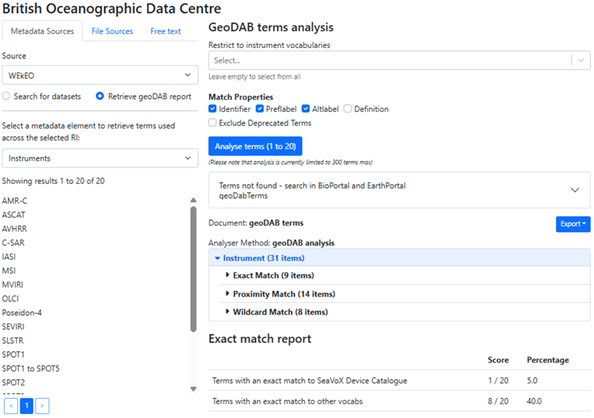
2. Tighter Integration with geoDAB
The SA now supports the analysis of geoDAB reports.
These reports are generated by scanning all metadata records associated with a Research Infrastructure (RI), extracting terms related to parameters, instruments, platforms, and keywords.
3. Free-text Box
A free-text search box has been added to the SA User Interface to allow users to match a single term or a single combination of terms to concepts held in the SA Knowledge Base.
4. User Interface Modernisation
The SA User Interface was redesigned and replaced with a more modern and intuitive layout, improving usability and accessibility for both technical and non-technical users.
5. Semantic Analyser API Deployment
A key advancement has been the implementation of the Semantic Analyser API, enabling automated, machine-to-machine interaction.
The API comprises five endpoints, all delivering responses in JSON-LD format based primarily on schema.org standards.
The core analysis functionality is accessed via a POST endpoint. swagger documentation
6. Knowledge Base Enhancements
Efforts are underway to incorporate mappings for commonly used terms that are not part of existing published vocabularies.
This includes the integration of manually curated mappings to better support real-world usage patterns and improve annotation coverage across datasets and metadata records.
7. Ongoing Development and Next Steps
Ongoing work is focused on refining the SA’s matching algorithms and expanding its Knowledge Base to yield more accurate and targeted results.
These developments reflect a continuous commitment to enhancing the SA to support the semantic enrichment and interoperability of environmental research data workflows.